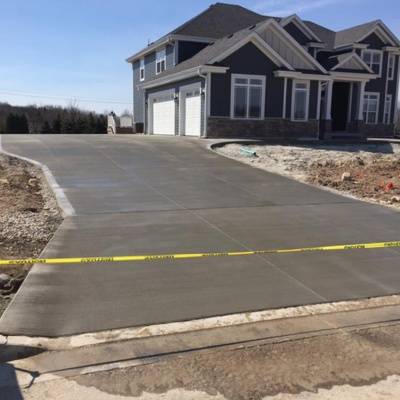
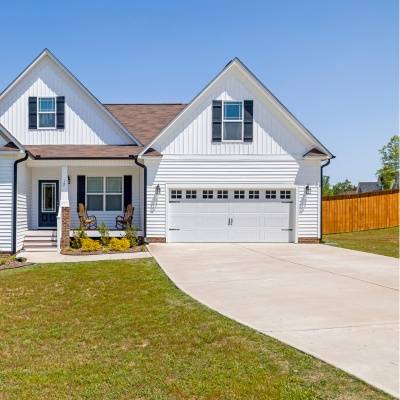
Midwest Concrete Technologies is a local Concrete Contractor in Berlin WI. This guide compares driveways, sidewalks, and patios. It also gives simple recommendations on mixes, finishes, slope and drainage, jointing and curing.
Comparing driveways, sidewalks, and patios
Driveways
Driveways handle vehicle loads. They need thicker slabs and stronger reinforcement. A 4–6 inch slab works for most passenger cars. Heavier vehicles need 6+ inches and rebar or mesh. Good subgrade compaction extends slab life.
Sidewalks
Sidewalks carry walking loads. They use a 4 inch slab. ADA and local codes set slopes and transitions. Smooth transitions reduce tripping.
Patios
Patios carry people and furniture. They often use a 4 inch slab. Decorative finishes are common on patios. Drainage and solid subgrade stop settling and cracking.
Why the differences matter. Thickness, reinforcement, and drainage affect freeze‑thaw performance in Wisconsin winters. The Portland Cement Association has guidance on mix and air entrainment for cold climates.
Recommended concrete mixes and slab thickness
Driveways
Use a 4,000 psi mix minimum for residential driveways. Place 5–6 inches where loads are higher. Add wire mesh or rebar for extra strength. Use 5–8% air entrainment for freeze‑thaw protection.
Sidewalks
Use 3,000–3,500 psi mixes. Make slabs 4 inches thick. Include 5–8% air entrainment.
Patios
Use 3,000–4,000 psi mixes. A 4 inch slab works for most patios. Add fiber reinforcement to limit hairline cracks.
Key notes. Use well‑graded aggregate and control water-to-cement ratio. Too much water weakens concrete. Local suppliers can adjust mixes for quick strength gain in cool weather.
Finish options
Broom finish
Broom finish gives traction and winter safety. It works well for sidewalks and driveways.
Trowel finish
Trowel finish gives a smooth surface. Use it for indoor slabs or some patios.
Exposed aggregate
Exposed aggregate looks decorative and holds up well. It needs extra finishing steps.
Stamped or colored concrete
Stamped or colored concrete adds curb appeal and costs more. Installers need experience for good results.
Tip. For Berlin winters pick finishes that keep traction like broom or light texture. Pair with a breathable sealer to reduce deicing salt damage.
Slope & drainage best practices
General rule. Provide 1%–2% slope away from buildings (about 1/8″–1/4″ per foot). Sidewalk cross slope must not exceed 2% to meet accessibility guidance.
Avoid long steep runs that push water to one spot. Break slopes into gradual pitches. Direct runoff to swales, drain inlets, or downspout extensions so water does not pond on the slab or near foundations.
Why it matters. Proper slope prevents water infiltration, freeze damage, and premature cracking.
Jointing & curing recommendations
Joint spacing. For 4″ slabs place control joints every 8–12 feet. For thicker slabs increase spacing proportionally. A common rule is 2–3 times slab thickness in inches equals spacing in feet.
Saw-cut timing. Cut control joints between 4–18 hours after finishing depending on conditions. Early cuts reduce random cracking.
Curing. Keep concrete moist for at least 7 days. In cool weather keep it moist longer. If water curing is not practical apply a curing compound immediately. Concrete reaches full design strength over 28 days.
Best practice. Use well placed control joints, a proper mix, and steady curing to limit uncontrolled cracking.
Final checklist before you start
- Confirm local permits and setback rules.
- Pick slab thickness, mix strength, and finish.
- Plan slope and drainage away from structures.
- Schedule the pour for favorable weather or plan cold‑weather protection.
- Get at least three written quotes if you hire a contractor.
For local estimates, contact Midwest Concrete Technologies — your local Concrete Contractor in Berlin WI.